

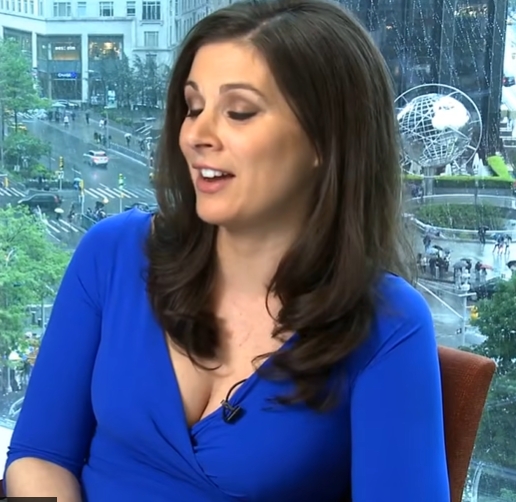
Erin Burnett is well aware of the unique type of fatigue that comes with anchoring a nightly cable news program. She has been covering everything from financial crises to Middle East conflicts five nights a week, live at 7 p.m., since 2011. the kind of schedule that causes the majority of people to grab takeout while driving home. Nevertheless, it’s difficult to ignore Burnett’s consistently calm and obviously healthy appearance when watching her on screen. There isn’t a striking before and after. No announcement of a sponsored detox. Just someone who appears to have discovered something in secret, without making headlines.
Her statements about fitness over the years don’t sound like advice from a magazine interview. It sounds like something a friend would tell you while strolling around the neighborhood in a stroller. Following her pregnancies, she talked about using her infant as a counterweight for at-home exercises, such as lunges while pushing a stroller, leg lifts on the floor of the living room, and Pilates exercises fit in between bath time and toy pickup. She once stated, “I’m not aiming to look perfect in a couple of months”, with a casualness that most wellness cultures would find difficult to capitalize on. It’s strangely refreshing to be honest like that.
| Category | Details |
|---|---|
| Full Name | Erin Isabelle Burnett |
| Date of Birth | July 2, 1976 |
| Birthplace | Mardela Springs, Maryland, USA |
| Education | Williams College – B.A. in Political Economy |
| Current Role | Anchor, Erin Burnett OutFront, CNN (since 2011) |
| Previous Employers | Goldman Sachs, Citigroup, Bloomberg Television, CNBC |
| Spouse | David Rubulotta (married 2012) |
| Children | Three |
| Known For | International reporting, financial journalism, primetime CNN anchor |
| Reference | CNN – Erin Burnett OutFront |
The larger narrative of Erin Burnett’s fitness and weight loss strategy isn’t really about weight loss, at least not in the sense that the term is typically used. She has never made a dress size or target number publicly known. Instead, a philosophy of integration emerges, which holds that formal exercise is a luxury of time and that the body still needs to move when time is limited. Rather than take a cab, go for a walk. Use the stairs. While you’re moving, perform the lunges. It’s not glamorous. It functions as well.
She was raised in Maryland, participated in field hockey and lacrosse during her high school and college years at Williams, and by all accounts, she never truly stopped being active. She now views her body as something that responds to regular, everyday movement rather than something that needs to be controlled by experts, which appears to be influenced by her athletic background. She seems to approach fitness in a similar manner to how she approaches a story: practically, without needless drama, with an eye toward the result.
Her interview with the CEO of Eli Lilly on “OutFront”, in which she talked about increased production of weight-loss medications, served as a reminder that Burnett frequently covers the very sector that has changed the way millions of Americans view their bodies. She has approached that area with the same analytical objectivity that she applies to Fed rate decisions. Although it’s still unclear if she has personally discussed GLP-1 medications, it’s plausible that focusing on those discussions gives her a more nuanced perspective than the majority of what circulates on social media. She has seen the trends emerge and is aware of how swiftly they change.
Burnett’s description is more akin to what exercise physiologists might refer to as “incidental activity” physical effort incorporated into everyday life as opposed to planned into it. She has discussed fish, making fruit and vegetable smoothies for her kids and then drinking them herself, breastfeeding as an excuse to eat more mindfully, and reducing her intake of sweets by being around loved ones rather than using willpower. It has a domestic logic that is difficult to refute.
Notably, Burnett’s three-word postpartum fitness philosophy was “balanced, flexible, forgiving”. The final word is often forgotten. It’s odd to lead with forgiveness in a media landscape that promotes urgency and change. This could be precisely the reason the strategy endures over years as opposed to weeks.
She has been with CNN for fourteen years, and she is one of the most enduring figures in primetime television, having survived numerous co-anchor partnerships, news cycles, and shows. It’s difficult to determine whether any of that stems from the same discipline she uses for her exercise regimen. It’s difficult to ignore the connection between the two when you see someone in that industry maintain that level of consistency over such a long period of time. She creates long-lasting habits. That isn’t a tale of transformation. It’s a real-time maintenance story, which is more engaging.
i) https://www.cnn.com/2012/01/17/us/erin-burnett-out-front-schools-track-kids-weight-loss
ii) https://irp.cdn-website.com/b450ca0f/files/uploaded/t.html
iii) https://revcardiologia.sld.cu/plugins/generic/pdfJsViewer/pdf.js/web/viewer.html
iv) https://www.cnn.com/videos/bestoftv/2012/01/16/erin-schools-track-kids-weight.cnn
v) https://www.women.com/2125469/stunning-transformation-erin-burnett-cnn/