

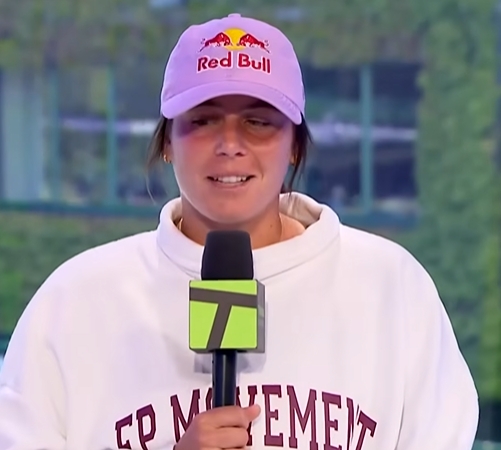
The way sports social media treats a woman recovering from illness is especially cruel. Before Emma Navarro’s first tour match was even over, fans began tallying pounds, keeping track of her appearance, and loudly speculating about what they saw from their couches. Reading it is uncomfortable. Furthermore, it completely misses the point.
Navarro, the 25-year-old American who climbed to World No. 8 in 2024 with what looked like effortless momentum, stepped away from the tour earlier this year for reasons that weren’t immediately public. She missed the WTA 500 in Charleston, her hometown, and the Miami Open. These are the kinds of competitions that a player in form doesn’t casually skip. It was a two-month absence. The void was filled by conjecture.
During ESPN’s coverage of Navarro’s Wimbledon match against Marta Kostyuk, commentator Chris McKendry verified the rumors that had been circulating in tennis circles: Navarro suffers from hypothyroidism. The thyroid gland small and butterfly shaped sitting at the base of the throat controls more metabolic processes than most people realize. When it underperforms as it does in hypothyroidism the effects accumulate slowly and then all at once. Fatigue, depression, Indeed, gaining weight the body slows down in ways that aren’t fully visible until they are.
The invisibility of hypothyroidism’s early stages makes it especially challenging for professional athletes to manage. The symptoms are not overtly noticeable. They appear as poor weeks, slow practices, and the feeling that recuperation is taking longer than it should. An underactive thyroid doesn’t just become a health problem on a tour as demanding as the WTA circuit constant travel, time zone shifts and the grind of back-to-back competitions.
It turns into a trap for performance. Navarro described the psychological and physical effects of constant competition and admitted that the tour schedule most likely made her condition worse. “It’s constant travel and a lot of stress on the body and the mind”, she said after her Roland Garros appearance in May.
Hypothyroidism is a lifelong condition, managed rather than cured. An endocrinologist monitors the majority of patients, and routine blood work is done to adjust medication dosages. The treatment works, but it requires patience, and the body doesn’t always cooperate on any timetable that suits a tennis calendar. Additionally, the condition can cause an underactive thyroid to swing toward hyperthyroidism over time or with inappropriate treatment, resulting in a completely different set of symptoms. Managing it properly is a long game.
The weight gain that sparked online criticism is not a sign of neglect or conceit. It is a known, predictable result of a medical condition that disproportionately goes undiagnosed for years and affects millions of women globally. It serves as a reminder of how little the context of illness is taken into account when evaluating female athletes in public when watching fans analyze Navarro’s body during a Wimbledon broadcast, with some speculating that she needed to “train and diet to get back to the right weight to compete”.
Additionally, those remarks completely missed the fact that Navarro returned and prevailed. The WTA 500 in Strasbourg, where she claimed the biggest title of her career, arrived less than a month after her return. That’s not the story of someone struggling to find form. It’s the story of someone who made a difficult, necessary choice to step off the hamster wheel her words, essentially and came back stronger for it.
Nowadays, there is a generation of tennis players who went pro after attending college and adjusting to life outside of the tour. Navarro, a former NCAA champion from the University of Virginia, appears to have carried that viewpoint with her. There was more to the two months away than just recuperation. By her own account, they were an exercise in figuring out how to exist as a human being alongside a career that can easily swallow everything else whole. That seems worth more than a few extra pounds ever could be.