

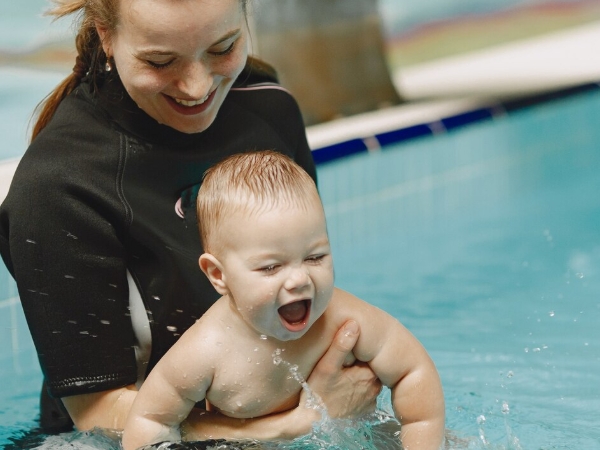
When a child becomes quiet near water, a parent feels a certain kind of dread. You’re not concerned about the splashing. It’s the quiet. Even if they haven’t expressed it aloud, anyone who has taken a vacation with a toddler at a beach, lake, or pool understands that feeling.
It’s not paranoia. It is supported by statistics that are becoming more difficult to ignore. The number of child drowning deaths in England increased from 20 in 2019–20 to 41 in 2022–2023, nearly doubling in less than four years, according to data released by the Royal Life Saving Society UK. Over that time, 125 children have perished in this manner. These are not abstract numbers that are tucked away in a report. They stand in for kitchen tables that are currently lacking a chair.
| Category | Details |
|---|---|
| Topic | Baby and toddler water safety ahead of the holiday season |
| Key statistic | Child accidental drowning deaths in England rose from 20 in 2019–20 to 41 in 2022–23 |
| Total recorded losses | 125 children have died from accidental drowning over the past four years |
| National fatality data | 202 accidental water-related fatalities were recorded across the UK in 2025 |
| Core survival technique | The RNLI’s Float to Live method, taught as an alternative to swimming immediately when in difficulty |
| Recommended equipment | U.S. Coast Guard-approved type II life jackets for children under five |
| Campaign | Drowning Prevention Week, run annually by the Royal Life Saving Society UK |
This is particularly disturbing because it frequently occurs in situations that appear to be perfectly safe. A bright afternoon. A serene reservoir. A jetty picnic with the family. That’s essentially what happened earlier this year when Lucie, then four years old, removed her life jacket while paddleboarding with her family while taking a break to eat. She fell into the water while playing a few minutes later.
Part worth sitting with is what transpired next. Lucie remained calm. She swam to the jetty and held on until assistance arrived after kicking to the surface and floating to steady herself. The moment was strangely calm, almost too calm, according to her mother Natasha, who only realized it after the adrenaline subsided. It’s difficult to ignore how much of that poise stems from lessons learned months prior rather than just instinct.
Under cold-water shock, instinct tends to work against you, so this distinction is important. The RNLI has been promoting its Float to Live message for years because the natural response—fighting the cold, thrashing, or trying to swim hard—often exacerbates the situation. Their recommendations—lean back, maintain open airways, extend arms and legs, and breathe slowly until the initial shock passes—go against common sense. Try calling for assistance or making your way to safety only after that.
Reuben Morgan, a fifteen-year-old who drowned in a reservoir almost twenty years ago, serves as an example of why this is important even for proficient swimmers. Since then, his mother, Maxine Johnson, has spent twenty years advocating that cold-water shock is not mitigated by physical fitness or swimming prowess. Reservoirs, rivers, and lakes can remain dangerously cold well into a heatwave, and warm air temperature has no bearing on water temperature. Every summer, season after season, people seem to be surprised by this particular detail.
Another issue is what parents pack for these excursions, which may seem insignificant at first. Brightly patterned swimwear and inflatable arm bands seem protective, but they frequently aren’t. Only neon yellow, green, and orange swimsuit styles could be seen under eighteen inches of water, according to research from Alive Solutions. Dark patterns made it more difficult, not easier, to identify children. For a toddler, a proper type II life jacket with a strap between the legs and head support is far more effective than floaties.
Because young children seldom express their thirst in the same way that adults do, hydration is also neglected. On a hot beach day, it’s not overly cautious to offer water or water-rich fruit about every 20 minutes because small bodies lose fluid more quickly than larger ones.
Families are not intended to be scared away by any of this. On the contrary, early exposure to structured safety skills, like Lucie’s, tends to produce calmer, more capable children rather than anxious ones, which is why Water Babies and similar swim programs exist. To give families a chance to practice the fundamentals before the high-risk months start, Drowning Prevention Week is purposefully scheduled ahead of school summer vacations.
Luck plays a part, it doesn’t seem to be the only factor that separates close calls that end well from those that don’t. It’s preparation that has already been practiced before the big day. In May, teaching a child how to float, call out, or hold the pool’s edge seems insignificant. By July, they are no longer small at all on a riverbank or jetty.
i) https://www.netmums.com/child/every-parent-should-watch-this-life-saving-water-safety-video-with-their-child-before-going-on-holidays
ii) https://www.happiestbaby.com/blogs/parents/beach-ocean-safety
iii) https://www.swim-central.uk/6-essential-water-safety-tips-for-parents-this-summer-holiday/
iv) https://www.waterbabies.co.uk/blog/summer-safety/
v) https://www.swimmingdad.com/single-post/babies-and-the-sea-parents-fears-and-dilemmas