

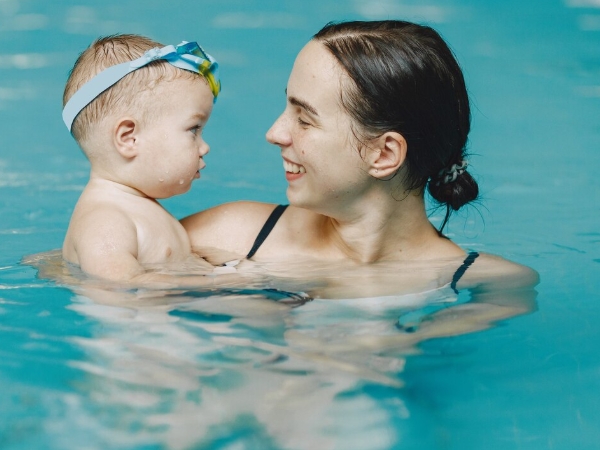
Parents of infants who swim frequently learn to recognize a certain sound: the slap of tiny palms against the surface, half joy, half disbelief. It’s not elegant. It’s not quite swimming yet. Most adults don’t realize what’s going on beneath the splashing, and this guide aims to bridge that gap.
The topic of baby swim safety is frequently discussed, but it is rarely discussed in detail. Without fully understanding what “start early” and “always supervise” actually mean, parents nod along when they hear these phrases. The ambiguity might be a contributing factor. When a toddler is truly, joyfully out of reach in three feet of water, general safety advice tends to be forgotten.
| Category | Details |
|---|---|
| Recommended starting age | Most UK providers, including Water Babies, accept infants from around three months old |
| Typical lesson length | Sessions usually run for about 30 minutes, often shorter than parents expect |
| Leading safety authority | The RoSPA Water Safety Code outlines the core principles for staying safe in or near water |
| Who should be in the water | Any parent, grandparent or guardian; non-swimmers and weak swimmers are typically still welcome |
| National guidance | The NHS advises constant, arm’s-length supervision for babies and toddlers near any water |
| Common myth | A “good swimmer” in a warm indoor pool may struggle badly in cold or open water |
| Where to learn more | Local leisure providers such as Better run some of the largest baby swim programmes in the country |
Most structured lessons start around three months of age, and there’s a reason for that window instead of, say, six weeks or six months. Instructors claim that this early familiarity tends to lessen fear later in life because babies still have some reflexive water responses from the womb. It is more difficult to demonstrate whether that results in swimmers who are measurably safer years later. It’s difficult to ignore how unconcerned a three-month-old appears, at least initially, when you watch them kick instinctively when lowered gently into warm water.
When you try to define supervision, it seems clear. In this regard, RoSPA’s guidelines are straightforward: water need not be deep, dramatic, or open in order to be hazardous. Every year, a disproportionate number of near-misses are caused by things like a garden paddling pool, a bath left unattended for ninety seconds, or a hot tub at a relative’s house during the holidays. A child can go under quietly, without the splashing or shouting that most adults associate with distress. This is an idea that the Water Safety Code repeatedly reiterates in various forms.
In a way, the whole point of baby swim safety is that silence. Seldom does drowning appear as it does in movies. There’s no scream for assistance, no flailing. While the adult two feet away is checking a phone, it’s more like a child just slipping beneath the surface. Because the message hasn’t quite caught on with the general public, lifeguards and swim instructors discuss it frequently, almost wearily. Keep your eyes on the child and your hands close at hand, not “in the room”, but within reach.
Even seasoned adults are caught off guard when dealing with cold water, which further complicates matters. The speed at which cold water from a lake or the sea depletes strength and coordination can truly astound a parent who swims confidently in a heated recreation center pool. Cold shock can occur in a matter of seconds, increasing breathing and heart rate in ways that make swimming even simple floating much more difficult than usual. Perhaps because indoor lessons predominate in the early years, it’s a detail that seldom appears in casual discussions about teaching children to swim.
And there’s the singing. The somewhat chaotic ritual of nursery rhymes belted out by tone-deaf parents holding wriggling infants is familiar to anyone who has attended a Dippers or Splashers class. From the poolside, it appears ridiculous. Teachers maintain that it actually does something: it keeps babies engaged, calm, and distracted during situations like submersion practice that could otherwise cause anxiety. It turns out that true water safety includes both physical skill and emotional comfort.
More than many parents realize, practicing at home is important. Blowing bubbles, pouring water over the face, and becoming at ease with water on the skin without panicking make bath time an unofficial continuation of the lesson. Since thirty minutes a week in the pool isn’t enough repetition on its own, teachers frequently purposefully send these little assignments home. Like most skills, confidence appears to develop gradually rather than in sudden, dramatic leaps.
It’s remarkable how little of the advice from RoSPA, the NHS, and swim providers is truly complex. Remain near. Recognize that the cold can deceive you. They’re quieter than you might think, so learn the signs. Don’t start lessons because of an imagined deadline, but rather when it works for your family. Naturally, none of this ensures anything; water is still unpredictable, and no guide completely eliminates the risk. It does move the odds in the right direction, paragraph by unglamorous paragraph.
i) https://www.penguinpediatrics.com/safety/a-parents-guide-to-water-safety
ii) https://www.rospa.com/water-safety/water-safety-code
iii) https://www.better.org.uk/what-we-offer/lessons-and-courses/swimming/baby-parent
iv) https://swimkids.us/about/first-lesson-guide/
v) https://raisingchildren.net.au/babies/health-daily-care/health-concerns/pool-hygiene