

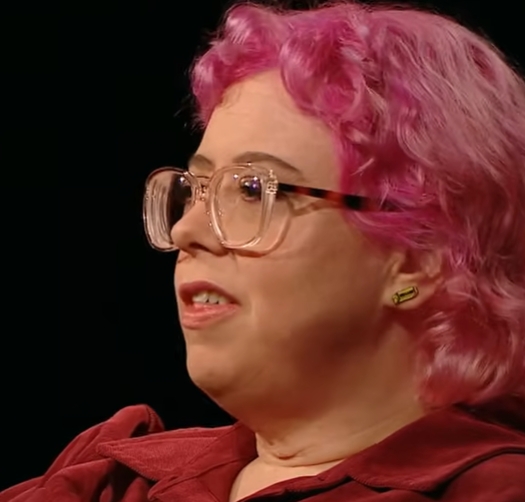
Seeing old footage of yourself and realizing that those around you take it as a compliment is a certain kind of cruelty. When Alison Spittle’s appearance on “Pointless Celebrities” finally aired in January, two years after it was filmed, that’s essentially what happened to her. Alongside her, friends and family marveled at how much smaller she had gotten.
Looking at the screen, Spittle recalled something completely different: it had been one of her happiest days ever. Her new stand-up show, “Big”, which is moving from Edinburgh to Dublin’s Project Arts Centre in September, revolves around the contrast between how she experienced her own history and how others perceived her body.
| Category | Details |
|---|---|
| Full Name | Alison Spittle |
| Born | June 1989, London, England |
| Raised | Ballymore, Co Westmeath, Ireland |
| Occupation | Comedian, writer, podcaster |
| Known For | Stand-up comedy, Nowhere Fast (RTÉ, 2017), Pointless Celebrities, Richard Osman’s House of Games |
| Current Show | Big — Edinburgh Fringe, then Dublin Fringe Festival, September 16–20 |
| Podcasts | Wheel of Misfortune (BBC), Magazine Party |
| Health Trigger | Cellulitis leading to septicaemia and hospitalisation |
| Weight Loss Method | Mounjaro (tirzepatide) injections |
| Partner | Simon Mulholland, co-writer on Nowhere Fast |
Alison Spittle’s weight loss could easily be presented as a neat redemption storyline: “jab, drop the pounds, applause”. That version doesn’t appeal to Spittle. She has stated unequivocally that she doesn’t want to condemn the person she once was and that there is an implicit expectation that she will do so in order to lose weight. Mourning a self that has shrunk rather than truly died is an odd form of grief.
Neither vanity nor a magazine cover served as the catalyst. It was an urgent medical situation. Spittle was hospitalized for weeks after developing cellulitis, which turned into septicemia. In essence, doctors informed her that losing weight was no longer an option. She was forced to agree because she had no other option. That origin story has an almost unremarkable quality, which is probably why it seems real: health crises don’t usually make a dramatic announcement; instead, they just happen and you have to deal with what’s in front of you.
She has been open about her use of Mounjaro, the same class of drug that is driving Ozempic’s cultural moment, and she is impatient with celebrities who attribute their transformations to “willpower” that most likely involved a prescription. It’s a sharp and reasonable point. She perceives the dishonesty surrounding weight-loss medications the insistence on walking and eating healthily as cover stories as a form of conceit masquerading as humility.
What she has said about appetite itself is perhaps more fascinating and more difficult to sum up. Before taking the medication, eating was more about self-soothing and numbing emotions she didn’t want to deal with than it was about being hungry. Mounjaro virtually completely inhibited that process, transforming food into something more akin to fuel than comfort. She has said that she misses the dopamine rush that comes from eating for pleasure, likening it almost nostalgically to doing laundry. You wouldn’t expect someone who is just celebrating a smaller dress size to say that.
As what she refers to as a “public fat person”, Spittle has spent years taking in criticism from strangers both in person and online, some of it condescending and some of it outright hostile. She has described confronting a man who had insulted her on a train and waking up to abusive messages following TV appearances, portraying the animosity as evidence that she was getting under people’s skin rather than something to be afraid of. The weight has vanished, but so has that defiance. If anything, it appears to have sharpened and is now directed at a different target: those who moralize about “how” someone loses weight and maintain that it must involve suffering in order to be considered legitimate.
She’s noticed that people now treat her differently, with more warmth and respect, which she finds unsettling rather than flattering. It implies that the respect she was due all along was contingent on a scale’s number, which is exactly the kind of conditional kindness she spent years rejecting.
Spittle, who was born in London and partially raised in Ballymore, County Westmeath, has made a career out of turning discomfort into material. She returned to her stand-up roots following a fortuitous encouragement from comedian Bernard O’Shea during a radio work placement. From “Nowhere Fast” to her podcasting career to “Big” itself, it seems that this instinct making people laugh before they have a chance to pass judgment has persisted throughout.
Resolution isn’t what makes her weight loss story compelling. It’s the refusal to express gratitude on demand combined with an open assessment of what has been quietly lost and what has been gained. Spittle doesn’t seem particularly concerned about being liked, but it remains to be seen if Dublin audiences will react to that ambivalence in the same way Edinburgh has. She has stated as much herself: she has come to the conclusion that a comedian can only go so far with likeability.
i) https://www.sundaypost.com/fp/it-was-scary-but-it-was-a-turning-point-in-my-life/
ii) https://evoke.ie/2025/09/04/entertainment/celebrity/alison-spittle-weight
iii) https://www.rte.ie/radio/radio1/clips/22533597/
iv) https://www.irishtimes.com/life-style/people/2025/08/09/alison-spittle-im-treated-more-like-a-human-being-now-ive-lost-weight/
v) https://www.rte.ie/lifestyle/living/2025/0728/1525667-alison-spittle-weight-has-been-a-constant-war-in-my-life/